
Samsung AC Error E203: Outdoor Communication Fault Repair
Diagnostic Protocol & Repair Guide
Technician Note
Always isolate power before inspecting high-voltage components.
System Fault Detected: Samsung AC Error E203: Outdoor Communication Fault Repair
Continuing to run equipment with this active code may void warranties or cause permanent mechanical failure.
Solved: Samsung AC Error E203
The Complete Guide to Fixing Outdoor Unit Communication Faults. Internal Wiring Diagnostics, PCB Testing, and Solutions.
Introduction to Samsung AC Error E203
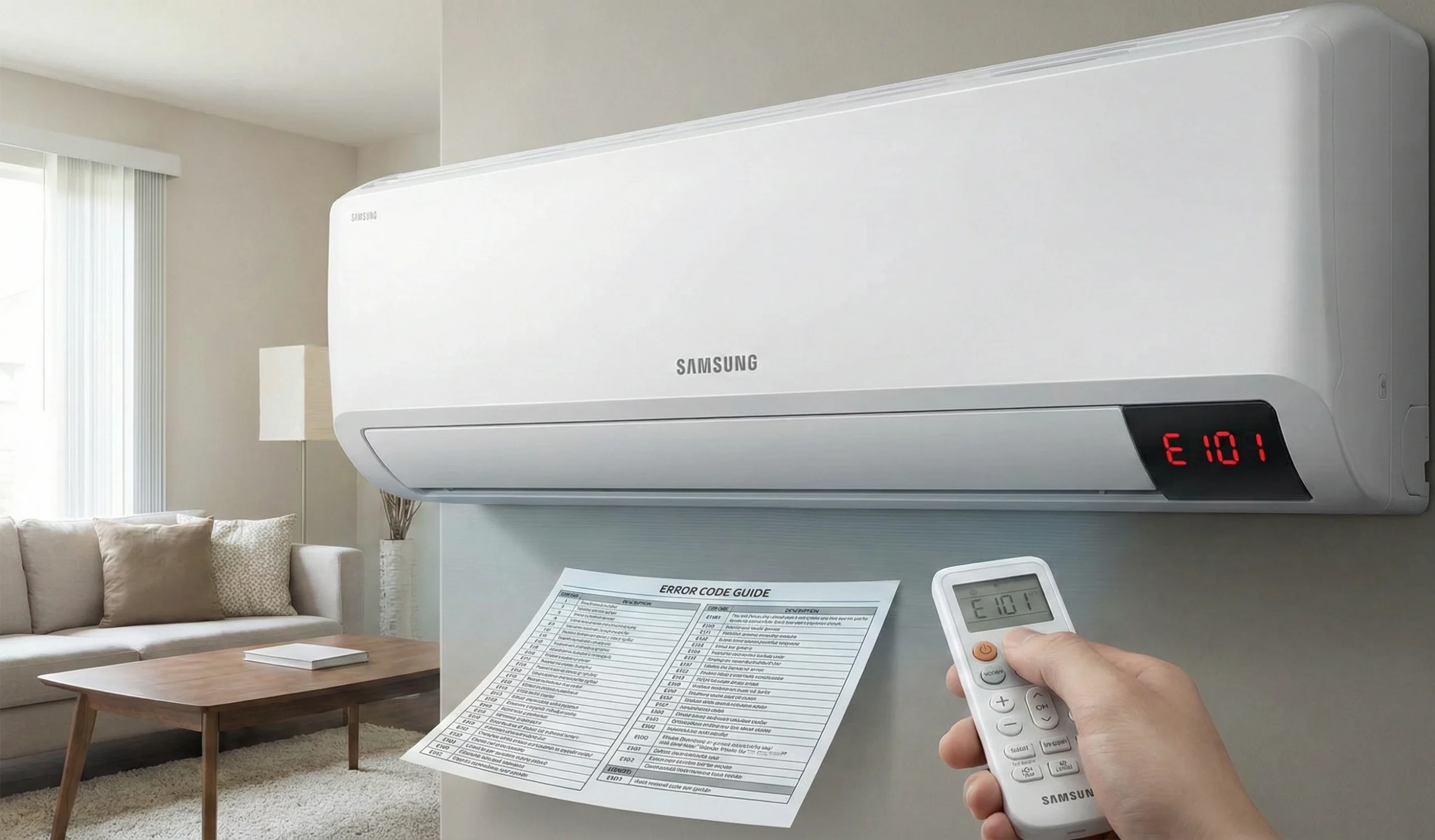
Unlike E101 or E201 which deal with communication between the indoor and outdoor units, the Samsung AC Error E203 is strictly an Outdoor Unit Communication Fault.
Modern Samsung outdoor units (especially high-capacity or VRF/DVM systems) contain multiple circuit boards. The two most critical are the Main PCB (which handles logic, sensors, and indoor comms) and the Inverter PCB (which handles high-voltage power delivery to the compressor). Error E203 triggers when the Main PCB’s microcontroller fails to receive a response from the Inverter PCB’s microcontroller within a strict time limit. This means the brain of the AC has lost control of its “muscle.”
Step-by-Step Diagnostic Procedure
Step 1: The Master Reset
Internal communication loops can stall due to electrical noise or minor power surges.
- Turn off the main electrical breaker to the AC.
- Wait exactly 5 minutes. The large DC link capacitors on the inverter board need time to discharge to 0V.
- Restore power. If the E203 error flashes again immediately upon startup, the hardware has failed.
Step 2: Inspecting Internal Harnesses
Open the top cover of the outdoor unit. You will see thick power cables and thin communication harnesses connecting the Main PCB to the Inverter PCB.
| Check Point | Common Issues | Action Required |
|---|---|---|
| Comm Harness (4 or 6 pin) | Vibration has caused the plug to come loose. | Unplug and reseat the connector firmly on both boards. |
| Wire Condition | Rat bites severing the TX/RX wires. | Repair or replace the internal harness. |
| Connector Pins | Oxidation / green corrosion on pins. | Clean with a specialized electronics contact cleaner. |
Step 3: Checking Inverter PCB Power Status
The Main PCB cannot talk to the Inverter PCB if the Inverter PCB is dead.
- Locate the diagnostic LEDs on the Inverter PCB (usually near the large capacitors or IPM module).
- LEDs are OFF: The inverter board is not receiving power. Check the main ceramic fuse (20A/30A) on the board. If the fuse is blown, the IPM or bridge rectifier has likely short-circuited.
- LEDs are ON/Blinking: The board has power, meaning the issue is strictly in the communication circuitry (Optocouplers/Comm ICs) between the two boards.
Step 4: Isolating the Faulty Board
If the wiring is perfect and both boards have power, one of the communication transceiver chips has failed. Because diagnosing which board’s TX (Transmit) or RX (Receive) chip is blown requires an oscilloscope, Samsung’s official protocol usually dictates replacing the Inverter PCB first, as it handles high voltage and is more prone to electrical damage.
DIY Repair vs. Professional Service
Pros of Professional Repair
- ✓ Component-Level Repair: Professionals can test and replace blown optocouplers (PC817, etc.) on the comms circuit, avoiding a full board replacement.
- ✓ High Voltage Safety: The Inverter PCB stores 380V DC. Experts use heavy resistors to discharge this before working.
- ✓ Accurate Diagnosis: Using an oscilloscope to “see” the data square-waves instantly identifies if the Main or Inverter board is the culprit.
- ✓ Thermal Paste Application: If swapping the Inverter PCB, professionals apply fresh thermal paste to the IPM to prevent it from burning out instantly.
- ✓ Warranty: Safe handling of logic boards keeps your manufacturer warranty intact.
Cons of DIY (Do It Yourself)
- ✗ Lethal Danger: Touching the wrong capacitor leg on an Inverter PCB can cause severe, life-threatening electric shock.
- ✗ “Parts Cannon” Mistake: E203 is notoriously tricky. Buying a $300 Inverter PCB only to find the $150 Main PCB was the actual problem is a costly error.
- ✗ IPM Destruction: Forgetting to apply thermal paste when installing a new Inverter board will destroy the board in 10 minutes.
- ✗ Static Electricity: Mishandling sensitive PCBs without an ESD strap can permanently corrupt the EEPROM.
- ✗ Voiding Warranty: Manufacturers reject claims if unauthorized repairs on logic boards are detected.
Estimated Repair & Parts Pricing
| Product / Service | Details | Estimated Cost | Action |
|---|---|---|---|
| Outdoor Main PCB | Handles overall outdoor logic | $150 – $280 | Check Price |
| Outdoor Inverter PCB | Drives compressor (High Voltage) | $250 – $480 | Check Price |
| Internal Comm Harness | Cable linking Main to Inverter board | $10 – $25 | Check Price |
| PCB Component Repair | Replacing Optocouplers / Comm ICs | $90 – $160 | Book Service |
* Prices vary based on AC tonnage (VRF/DVM systems use much more expensive boards) and local labor rates.
Related Samsung Error Codes
Frequently Asked Questions
1. What is the difference between E201 and E203?
E201 is a communication failure between the indoor unit in your room and the outdoor unit. E203 is a failure completely localized inside the outdoor unit (between its two internal circuit boards).
2. Can a power surge cause E203?
Yes. A surge can fry the delicate optocouplers that pass signals between the Main PCB and Inverter PCB, severing their connection.
3. Do I need to check the F1/F2 wires for this error?
Generally, no. F1 and F2 connect the indoor unit to the outdoor unit. E203 points to a problem with the internal harness *inside* the outdoor unit.
4. Can I just replace the blown fuse on the Inverter PCB?
You can try, but fuses blow for a reason. If the 20A/30A fuse is blown, the IPM (Intelligent Power Module) has likely shorted. A new fuse will instantly blow again when power is applied.
5. Why are there two boards in the outdoor unit anyway?
Safety and heat management. The Main PCB runs on 5V/12V DC logic. The Inverter PCB handles dangerous 380V DC power. Keeping them separate protects the logic “brain” from high-voltage heat and electrical noise.
6. Are option codes required if I change the outdoor board?
Typically, no. Outdoor boards usually have hardware DIP switches or are pre-programmed for specific chassis sizes. Indoor boards require option code entry via remote.
7. Do rats cause E203 errors?
Yes. Rats nesting in the outdoor unit frequently chew through the thin data ribbon cables connecting the Main and Inverter PCBs.
8. How can a professional tell which board is broken?
They use an oscilloscope to probe the TX (Transmit) and RX (Receive) pins. If the Main board is sending square waves but the Inverter board is sending a flat line, the Inverter board is faulty.
9. Does Atlas Aircons repair Samsung PCBs?
Yes, we provide specialized micro-soldering and board-level repairs, addressing blown communication chips to save you from buying entirely new boards.
10. Can a failing compressor cause E203?
Rarely, but possible. If a short-circuited compressor blows the Inverter PCB’s IPM, the Inverter PCB dies and stops communicating, triggering E203.
Bypass The Downtime
Do not waste hours deciphering manuals. The Atlas Aircon engineering squad has successfully cleared the Samsung AC Error E203: Outdoor Communication Fault Repair across multiple industrial sites. We can dispatch a technician to your facility immediately.
GET LIVE TROUBLESHOOTING⚡ ISO 9001:2015 Certified Diagnostic Team