
Fix Panasonic AC Error H11: Communication Failure Repair Guide
Diagnostic Protocol & Repair Guide
Technician Note
Always isolate power before inspecting high-voltage components.
System Fault Detected: Fix Panasonic AC Error H11: Communication Failure Repair Guide
Continuing to run equipment with this active code may void warranties or cause permanent mechanical failure.
Solved: Panasonic AC Error H11
The Complete Guide to Fixing Panasonic Indoor/Outdoor Communication Failures. Wiring Diagnostics, Terminal 3 Tests, and PCB Solutions.
Introduction to Panasonic AC Error H11
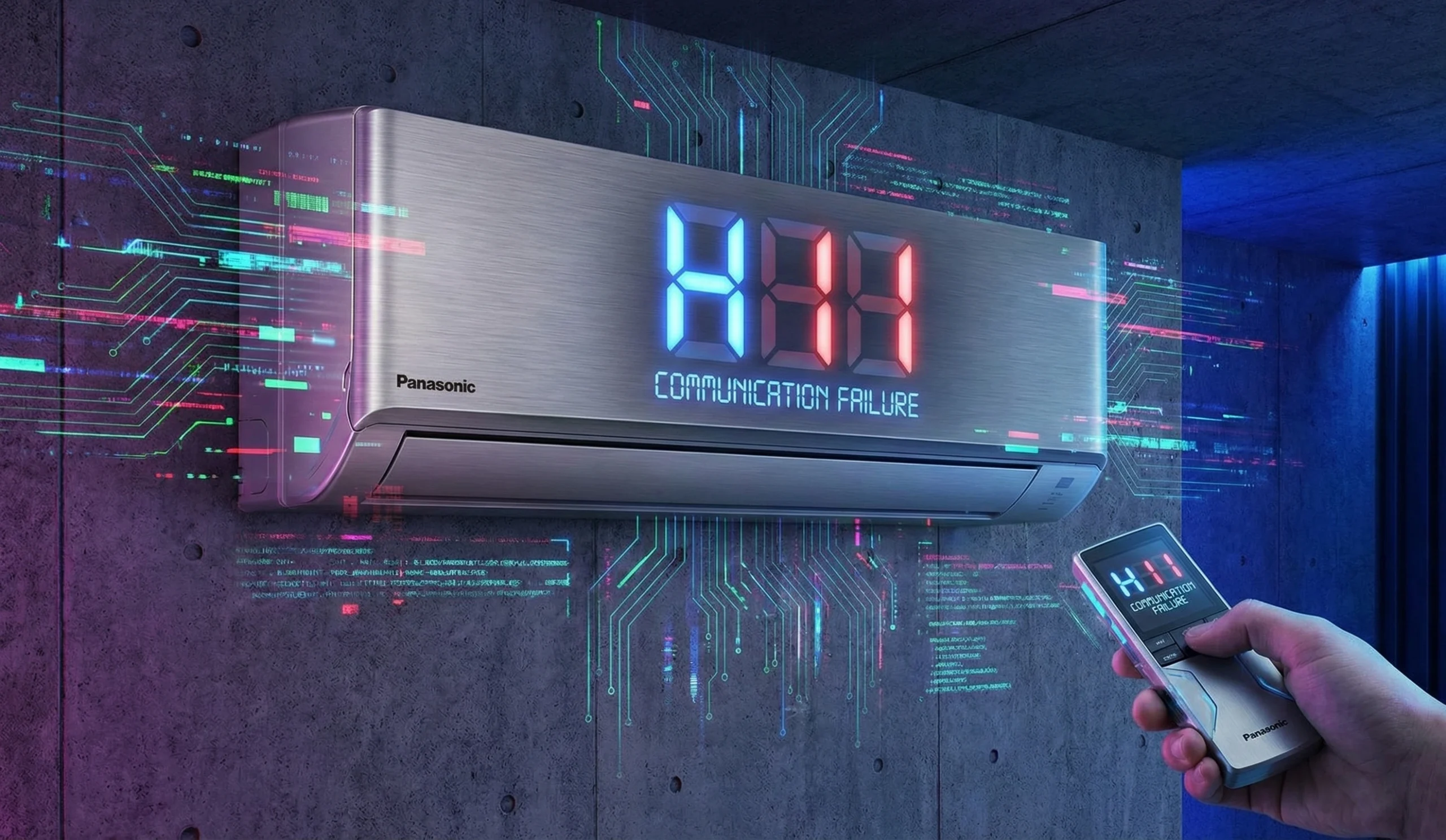
The Panasonic AC Error H11 is a critical diagnostic code that specifically indicates an Indoor/Outdoor Communication Abnormality. Panasonic inverter air conditioners rely heavily on continuous digital feedback to operate efficiently.
When you switch on the AC, the indoor unit begins sending signals to the outdoor unit. If the indoor PCB does not receive a valid data return signal from the outdoor PCB for 1 minute, it immediately locks out the system, stops the fan, and displays the H11 error (or flashes the timer light) to prevent catastrophic electrical damage.
Step-by-Step Diagnostic Procedure
Step 1: The Standard Reboot
Before disassembling the unit, rule out a logic loop glitch caused by brief power outages or static electricity.
- Locate the main circuit breaker/isolator for the Panasonic AC.
- Switch it OFF and wait for a full 5 minutes. This ensures all inverter capacitors are drained.
- Turn the power back ON. If the AC starts but the H11 error returns after exactly 1 minute, you have a hard fault.
Step 2: Inspecting Terminal Wiring (1, 2, 3)
Panasonic uses a standard 3-wire system between the indoor and outdoor units. Terminals 1 and 2 carry AC power, while Terminal 3 is the dedicated communication line.
| Check Point | Potential Issues | Action Required |
|---|---|---|
| Terminal Block Tightness | Screws on Terminal 3 vibrating loose over time. | Tighten screws on terminals 1, 2, and 3 on both units. |
| Wire Integrity (Wire 3) | Rodent damage breaking the data line inside the wall. | Check continuity of Wire 3 from indoor to outdoor unit. |
| Cross-Wiring | Terminal 2 connected to 3 at the other end. | Ensure colors match perfectly (e.g., Red to 1, Black to 2, Green to 3). |
Step 3: The Terminal 3 Voltage Fluctuation Test
To determine if the PCBs are functioning, test the communication voltage using a Multimeter.
- Set your multimeter to DC Voltage (some older Panasonic models may require setting to AC voltage; check service manual, but DC is standard).
- Place the black probe on Terminal 2 (Neutral) and the red probe on Terminal 3 (Data).
- Healthy Reading: The voltage must rapidly fluctuate (e.g., bouncing randomly between 15V and 35V DC). This confirms data packets are traveling.
- Static or 0V Reading: If the voltage stays at exactly 0V, or stays solid at a high voltage with no bouncing, the communication circuit (usually the outdoor PCB) is dead.
Step 4: Isolating the Outdoor PCB
If the Terminal 3 test fails, 90% of the time, the Outdoor PCB has failed. Verify this by checking the outdoor board:
Remove the outdoor top cover. Check the large ceramic or glass fuse on the outdoor PCB. If the fuse is blown, the board suffered a major short (often the IPM chip) and completely died, which breaks communication and triggers the H11 indoors.
DIY Repair vs. Professional Service
Pros of Professional Repair
- ✓ Exact Diagnosis: Pros can use specialized diagnostic tools to determine instantly if the Indoor or Outdoor PCB is the source of the H11 error.
- ✓ Micro-Soldering: Instead of buying a new $250 board, technicians can often replace the blown optocoupler ICs on the communication circuit.
- ✓ Safety: Panasonic outdoor capacitors hold 300V+ DC. Pros know how to safely discharge them before touching the PCB.
- ✓ EEPROM Checks: They ensure the newly installed board is compatible and properly formatted for your specific AC tonnage.
- ✓ Warranty Protection: Authorized service ensures you do not void the compressor’s long-term warranty.
Cons of DIY (Do It Yourself)
- ✗ Misdiagnosing the Board: Buying a new Indoor board only to discover the Outdoor board was actually the problem wastes hundreds of dollars.
- ✗ Electrocution Hazard: Measuring Terminal 2 to 3 requires touching live electrical contacts next to a 240V mains feed.
- ✗ IPM Destruction: Failing to apply thermal paste correctly to a new outdoor PCB’s heat sink will destroy the new board instantly.
- ✗ Incorrect Wiring: Mixing up terminal 2 and 3 during a DIY wire replacement can short circuit both boards simultaneously.
Estimated Repair & Parts Pricing
| Product / Service | Details | Estimated Cost | Action |
|---|---|---|---|
| Panasonic Outdoor PCB | Main Inverter Board (Most common H11 fix) | $180 – $350 | Check Price |
| Panasonic Indoor PCB | Indoor controller unit | $120 – $220 | Check Price |
| Communication Cable (3-Core) | Heavy duty copper interconnect wire (Per Meter) | $2 – $5 | Check Price |
| PCB Component Repair | Replacing Communication ICs / Optocouplers | $80 – $140 | Book Service |
* Prices vary based on AC tonnage and local market rates. Inverter boards are model-specific.
Related Panasonic Error Codes
Frequently Asked Questions
1. Why does my Panasonic AC blink the timer light and not cool?
A blinking timer light is Panasonic’s way of indicating an error. Using the remote to run a self-diagnosis will likely reveal the H11 code, meaning the units cannot communicate.
2. How do I read the error code with my remote?
Hold the “CHECK” button on your Panasonic remote for 5 seconds. Use the timer up/down arrows to scroll. When you reach “H11”, the AC unit will beep continuously.
3. Is it usually the Indoor or Outdoor PCB causing H11?
Statistically, the Outdoor PCB is the culprit 80% of the time, as it is exposed to harsh weather, heat, and grid power surges.
4. Can low refrigerant gas cause an H11 error?
No. H11 is purely an electrical data transfer fault. Gas issues will trigger different codes, such as F91.
5. Can I bypass Terminal 3?
Absolutely not. Terminal 3 carries the digital instructions that tell the outdoor compressor what speed to run at. Without it, the system cannot function.
6. Can rats cause the H11 error?
Yes, rodents frequently chew through the interconnecting cables linking the indoor and outdoor units, physically cutting the communication line.
7. Will a voltage stabilizer fix this?
A stabilizer will prevent future voltage spikes from damaging the PCB, but if H11 is already displaying, the internal circuitry is likely already broken.
8. How do I know if the cable is the issue?
You must test the cable’s continuity using a multimeter. If the wire has high resistance or is open-circuit, the cable needs replacing.
9. Does Atlas Aircons repair Panasonic PCBs?
Yes, we provide specialized micro-soldering and board-level repairs, replacing blown communication chips (optocouplers) to save you money.
10. Can a loose ground wire cause this?
Yes. Inverter ACs generate a lot of electrical noise. Without a solid earth connection, this noise can interfere with the data signal on Terminal 3, causing an H11 fault.
Bypass The Downtime
Do not waste hours deciphering manuals. The Atlas Aircon engineering squad has successfully cleared the Fix Panasonic AC Error H11: Communication Failure Repair Guide across multiple industrial sites. We can dispatch a technician to your facility immediately.
GET LIVE TROUBLESHOOTING⚡ ISO 9001:2015 Certified Diagnostic Team