
Fix Lloyd AC Error E3: Indoor Coil Sensor Repair Guide
Diagnostic Protocol & Repair Guide
Technician Note
Always isolate power before inspecting high-voltage components.
System Fault Detected: Fix Lloyd AC Error E3: Indoor Coil Sensor Repair Guide
Continuing to run equipment with this active code may void warranties or cause permanent mechanical failure.
Solved: Lloyd AC Error E3
The Complete Wiki Guide to Fixing Indoor Coil Sensor Faults. Resistance Charts, PCB Diagnostics, and Sensor Replacement.
Introduction to Lloyd AC Error E3
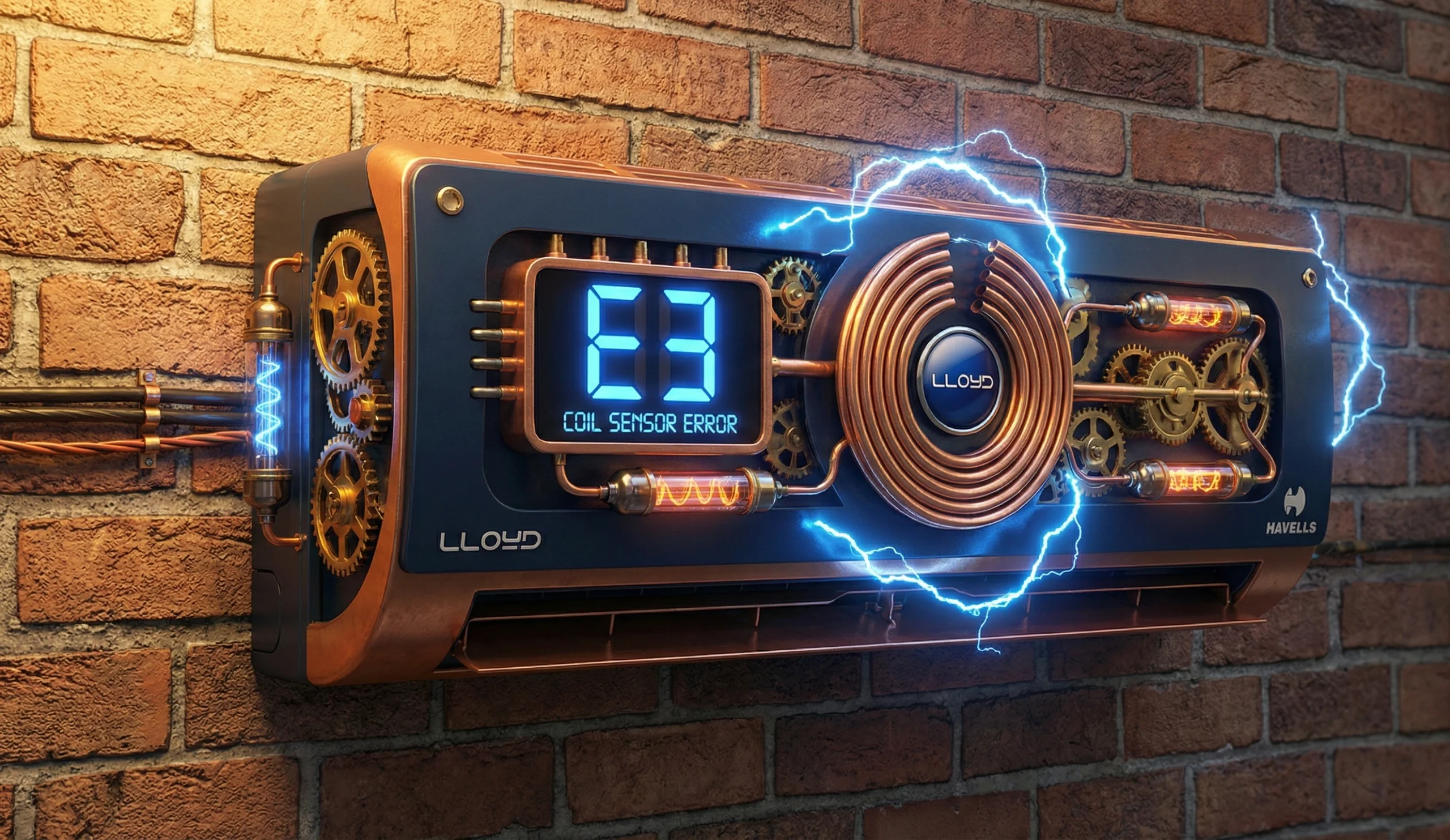
The Lloyd AC Error E3 is a direct diagnostic code that points to an Indoor Coil Sensor Abnormality. This sensor, also known as the Evaporator Pipe Thermistor, is a crucial component that constantly monitors the temperature of the indoor copper coils.
The main printed circuit board (PCB) uses this temperature data to prevent the indoor unit from freezing into a block of ice and to manage the compressor’s inverter speed. When the PCB detects that the sensor’s circuit is completely open (broken wire) or completely shorted, it shuts off the AC and flashes E3 to protect the system.
Step-by-Step Diagnostic Procedure
Step 1: Visual Inspection (The Rat Check)
Before testing electronics, look for physical damage. The indoor unit is a common nesting ground for rodents.
- Power OFF: Turn off the main breaker to the AC.
- Open the Cover: Lift the front panel and remove the right-side plastic casing to expose the PCB area.
- Find the Sensor: Look for a thin wire (usually black or twin-core) leading to a copper cylinder clipped onto the U-bends of the evaporator coil.
- Look for Bites: If the wire is chewed through, you have an “Open Circuit,” causing the E3 error.
Step 2: Connector Security Check
Air conditioners vibrate continuously. Over time, the plastic plug connecting the sensor to the PCB can wiggle loose.
Locate the sensor’s socket on the mainboard (often labeled CN_PIPE, TH1, or similar). Unplug it, check for any green/white corrosion on the pins, and push it firmly back into place until it clicks. Turn the power on to see if E3 clears.
Step 3: The Resistance Test (Gold Standard)
If the wire is intact and plugged in, the internal thermistor resistor may have degraded. You need a multimeter set to Ohms (kΩ).
| Condition | Reading (Ohms) | Diagnosis |
|---|---|---|
| Short Circuit | Near 0 Ω | Faulty. Sensor is fused internally. Replace it. |
| Open Circuit | Infinite (OL) | Faulty. Wire is broken internally. Replace it. |
| Normal (at 25°C) | Usually 5 kΩ or 10 kΩ * | Healthy. The sensor is fine; the PCB is likely at fault. |
* Note: Lloyd ACs predominantly use 5kΩ or 10kΩ NTC sensors for the indoor coil. Consult your specific model’s service manual.
Step 4: PCB Voltage Output Check
If the sensor tests perfectly healthy (e.g., exactly 10kΩ at room temp), but E3 persists, the main PCB is “deaf.”
With the AC powered ON and the sensor plugged in, carefully use a multimeter to measure the DC voltage across the sensor pins on the back of the board. The PCB should be supplying approximately 5V DC to the sensor circuit. If the voltage is 0V, the microprocessor or voltage regulator on the PCB has failed.
DIY Sensor Replacement vs. Professional Service
Pros of Professional Repair
- ✓ Exact Resistance Matching: Professionals carry OEM Lloyd sensors. Using a 10kΩ sensor when a 5kΩ is required will cause the AC to freeze solid.
- ✓ Proper Splicing: If rats chewed the wire at the root, pros can solder and heat-shrink the connections permanently, preventing future moisture shorts.
- ✓ PCB Diagnosis: They can accurately distinguish between a bad sensor and a bad ADC (Analog-to-Digital Converter) on the mainboard.
- ✓ Safe Handling: Modern inverter indoor PCBs sit right next to live 240V AC terminals. Pros know what not to touch.
- ✓ Warranty Protection: Certified technicians provide warranties on the parts they install.
Cons of DIY (Do It Yourself)
- ✗ Wrong Sensor Curve: Even if you buy a 10kΩ sensor, if the “Beta Value” is wrong, the AC will misread temperatures at the extremes.
- ✗ Breaking Plastic Clips: Removing the indoor unit’s casing without knowing where the hidden tabs are often results in snapping the plastic chassis.
- ✗ Loose Fit: The copper head of the sensor must fit tightly into its copper sleeve. A loose DIY fit means it measures the air, not the pipe, causing erratic operation.
- ✗ Shorting the PCB: Accidentally touching multimeter probes together while testing the live PCB will instantly blow the microprocessor.
- ✗ Tape Failures: Using standard electrical tape to splice sensor wires inside a wet AC unit will fail within months due to condensation.
Estimated Repair & Parts Pricing
| Product / Service | Details | Estimated Cost | Action |
|---|---|---|---|
| Lloyd Indoor Coil Thermistor | OEM copper-head pipe sensor (5k/10k) | $10 – $25 | Check Price |
| Sensor Wire Splicing & Repair | Fixing rat bites with solder & heat shrink | $30 – $50 | Book Service |
| Lloyd Indoor PCB Repair | Fixing 5V sensor circuit on mainboard | $60 – $100 | Book Service |
| AC Deep Cleaning Service | Recommended after rat infestation | $30 – $60 | Book Service |
* Prices vary based on AC model year (Inverter vs Non-Inverter) and local market labor rates.
Related Lloyd AC Error Codes
Frequently Asked Questions
1. Can I run my Lloyd AC with the E3 error?
No. The E3 error is a hard lockout. The AC stops the compressor to protect itself because it cannot monitor the cooling coil’s temperature. Bypassing it is not recommended.
2. Where exactly is the indoor coil sensor located?
It is attached to the indoor unit’s evaporator coil. If you lift the front plastic flap and remove the filters, you will usually see a wire leading to a copper sleeve on the right side of the metal fins.
3. What is the difference between a Room Sensor and a Coil Sensor?
The Room Sensor (plastic head) measures the air temperature of your bedroom to turn the AC on and off. The Coil Sensor (copper head) measures the temperature of the refrigerant pipes to prevent freezing.
4. Can I fix an E3 error by resetting the AC?
Sometimes. If it was a temporary voltage glitch, turning the main breaker off for 5 minutes might clear it. If the wire is chewed or the sensor is dead, the error will return immediately.
5. Why do rats chew these specific wires?
Sensor wires use a soft, flexible PVC/silicone insulation that is very easy for rodents to chew on to file their teeth. They often nest in the warm, dry PCB area.
6. How can I test the sensor without a multimeter?
You cannot accurately test it without a multimeter. However, a visual inspection for broken wires or a disconnected plug solves a large percentage of E3 faults.
7. Are Lloyd and Havells AC parts interchangeable?
In most modern units, yes, since Havells owns the Lloyd brand. However, you must always match the exact resistance (e.g., 10kΩ) of the thermistor, regardless of the brand name on the box.
8. Can I use a generic sensor from Amazon?
It’s risky. Generic sensors often have different NTC (Negative Temperature Coefficient) curves. The AC might think the coil is 5 degrees colder or warmer than it actually is, leading to poor cooling.
9. Does Atlas Aircons repair Lloyd PCBs?
Yes, if your sensor is fine but the PCB’s voltage regulator is blown, we can perform component-level repairs on the mainboard.
10. How can I prevent rats from causing this again?
After repairing the wire, seal the hole in the wall where the copper pipes enter the house using white cement or expanding foam. Do not leave gaps for rodents to enter.
Bypass The Downtime
Do not waste hours deciphering manuals. The Atlas Aircon engineering squad has successfully cleared the Fix Lloyd AC Error E3: Indoor Coil Sensor Repair Guide across multiple industrial sites. We can dispatch a technician to your facility immediately.
GET LIVE TROUBLESHOOTING⚡ ISO 9001:2015 Certified Diagnostic Team